ChatGPT Ads: How to Launch, Measure and Evaluate Campaigns
Date : October 30, 2026 By
ChatGPT Ads are labelled paid placements shown separately from ChatGPT’s answers to eligible users. Advertisers can create campaigns in Ads Manager, describe relevant conversation contexts, set bids and budgets, and track clicks or conversions. I have already launched ChatGPT Ads for 3 various businesses (2 Australian companies: one B2B and one B2C, and 1 international technology company), therefore I’d like to share my personal experience with it. For all companies, the sensible starting point is a controlled test with a clear conversion goal and sales-quality measurement—not an assumption that conversational advertising automatically produces better leads.
ChatGPT Ads: Results from My Enterprise B2B Campaign
To evaluate ChatGPT Ads in practice, I launched a campaign for an international enterprise technology vendor, testing six conversational targeting themes across 28 ads. The October 2026 pilot produced the following results:
| Campaign metric | Result |
|---|---|
| Paid clicks | 6,591 |
| Average CPC | US$0.44 |
| ChatGPT Ads Manager conversions | 24 |
| Cost per reported conversion | US$119.77 |
Of the 24 reported conversions, we independently identified eight contact and trial form conversions through UTM parameters. The remaining 16 were content downloads. Several contact and trial enquiries demonstrated commercially relevant intent, including enterprise-scale requirements, pricing enquiries and evaluations of alternative infrastructure solutions.
The results also revealed substantial differences between conversational targeting themes. Independent disaster recovery generated the most conversions, while virtualisation achieved the lowest cost per reported conversion at US$34.50.
My main takeaway: ChatGPT Ads can generate commercially relevant B2B enquiries, but the choice of conversational targeting themes and the quality of resulting leads matter more than traffic volume alone. I explain the campaign setup, performance differences and attribution findings in the detailed case study below.
What are ChatGPT Ads and where can users see them?
ChatGPT Ads are sponsored messages presented separately from the assistant’s response, normally below it. OpenAI says advertisers cannot influence the answers ChatGPT generates by purchasing advertising. An ad is not an endorsement or a recommendation from the assistant.
A standard ad contains an advertiser name and logo, headline, description, image and landing-page link. The current advertiser product is called OpenAI Ads Manager Beta. OpenAI introduced beta self-service access and click-based bidding on 5 May 2026, after an earlier advertising pilot. The interface, geographic availability and eligible formats may continue changing during the beta.
As of this review, OpenAI describes ads for eligible Free and Go users, not Plus, Pro, Business, Enterprise or Edu accounts. Advertiser and audience eligibility varies by geography; a business should check the current eligibility guidance before preparing a location-specific media plan.
This separation between answers and paid placements is important. Advertising on ChatGPT is not the same as being mentioned organically by ChatGPT. Buying ads does not buy a favourable answer.
How does ChatGPT Ads targeting work compared with Google Ads?
ChatGPT Ads uses the context and intent of eligible conversations, together with advertiser-provided information and permitted relevance signals. Rather than building an exact-match search keyword list, advertisers can describe relevant topics and situations through context hints at ad-group level.
OpenAI states that context hints guide matching but do not guarantee delivery for a particular question. Landing-page relevance and the ad’s headline and description can also contribute to selection.
| Comparison | Google Search Ads | ChatGPT Ads |
|---|---|---|
| Primary user context | Search query and other auction signals | Eligible conversation context and other permitted signals |
| Advertiser input | Keywords, match types and targeting, depending on campaign | Ad groups, context hints, targeting, creative and landing page |
| Exact-match phrase control | Supported in relevant search campaigns | Context hints are not exact-match keywords |
| Placement | Paid listings in Google search inventory | Clearly labelled sponsored unit, separate from ChatGPT answers |
| Quality measurement | Qualified leads, opportunities and customers | The same commercial outcomes, with platform-specific attribution rules |
For example, a company selling procurement software might test distinct illustrative themes: controlling purchase orders, connecting purchasing with accounting, or replacing manual approval workflows. Each theme should lead to a page that addresses that problem.
I find this approach particularly promising for advertising efficiency because ChatGPT Ads can interpret the broader meaning and intent of a conversation rather than relying on individual search keywords. According to OpenAI’s explanation of its advertising architecture, the system summarises relevant conversational context, creates semantic representations and uses them to identify potentially relevant ads. This allows advertisers to reach users discussing a problem even when they never mention the advertiser’s preferred keywords.
However, this does not automatically guarantee greater advertising efficiency. Semantic matching gives advertisers less direct control over the exact conversations in which their ads appear. Context hints are relevance signals, not strict targeting rules or exclusions. Advertisers cannot require their ads to appear only when users mention particular phrases, although separate geographic, audience and other supported targeting controls can restrict eligibility.
For advertisers requiring precise control over impressions, ChatGPT Ads may therefore be less suitable than traditional Google Search Ads. This is particularly relevant to companies operating in narrow markets, targeting highly specific technical requirements or needing to exclude closely related but commercially irrelevant searches. Google Search campaigns offer more explicit keyword and negative-keyword controls.
My recommendation is to treat ChatGPT Ads as a complementary channel rather than a direct replacement for Google Search Ads. Its potential advantage is discovering relevant commercial intent across conversations; its limitation is reduced control over exactly which conversations generate impressions. Advertisers should evaluate that trade-off through qualified leads and sales opportunities, not simply lower click costs.
Why might conversational ChatGPT advertising matter for B2B buyers?
Conversational advertising offers B2B companies another way to reach prospective customers during product research and evaluation. I see particular value in testing ChatGPT Ads when existing channels generate too few qualified leads, acquisition costs are becoming unsustainable, or additional spending produces diminishing returns.
There is also evidence that AI-assisted research is becoming part of B2B purchasing. A Gartner release dated 20 May 2026 reported that 45% of 645 surveyed B2B buyers had used generative AI during a recent purchase process (fieldwork August–September 2025), while 69% preferred validating AI-generated insights with sales representatives.
In January 2026, Forrester discussed its 2025 Buyers’ Journey survey findings on AI-assisted and zero-click buying. A separate Semrush study published in July 2026 examined how US B2B professionals use AI tools to discover and compare suppliers.
These findings support testing conversational advertising, but they do not establish how many B2B buyers are reachable through ChatGPT Ads or whether the channel will outperform existing advertising.
When can ChatGPT Ads help generate additional enterprise leads?
ChatGPT Ads may be worth testing when a company targeting enterprise buyers struggles to generate enough qualified opportunities through Google Ads, LinkedIn Ads or other established channels.
Enterprise buyers often research specialised operational challenges without using the product-category terminology preferred by vendors. Context hints allow advertisers to describe these situations rather than relying exclusively on individual search keywords.
For example, a cybersecurity software vendor could test conversations about recovering business-critical systems after ransomware attacks, rather than focusing solely on searches for specific recovery products.
My recommendation: Test two or three narrowly defined business problems and evaluate whether the resulting enquiries come from relevant companies with genuine purchasing requirements.
Can ChatGPT Ads reduce an unacceptably high cost per lead?
When Google Ads or LinkedIn Ads becomes too expensive, ChatGPT Ads offers another auction environment worth testing. However, lower click costs do not necessarily translate into lower customer acquisition costs.
Consider an Australian B2B software company spending A$10,000 monthly on Google Ads and generating 20 leads, at an average CPL of A$500. It could reallocate A$2,000 to a ChatGPT Ads pilot while maintaining A$8,000 in Google Ads.
| Metric | Existing Google Ads | ChatGPT Ads pilot |
|---|---|---|
| Monthly budget | A$8,000 after reallocation | A$2,000 |
| Primary objective | Maintain existing qualified demand | Test incremental qualified demand |
| Main evaluation metric | Cost per sales-qualified lead | Cost per sales-qualified lead |
| Decision | Retain or adjust spend based on marginal performance | Expand, revise or discontinue based on results |
This is an illustrative allocation, not a performance forecast. The experiment should account for opportunities potentially lost through reduced Google Ads spending and compare sales-qualified outcomes rather than simply reported CPL.
Can ChatGPT Ads help when Google Ads or LinkedIn Ads reach diminishing returns?
Established campaigns can become difficult to scale efficiently. Increasing Google Ads budgets may bring progressively more expensive conversions, while narrowly targeted LinkedIn campaigns can experience audience saturation.
For example, consider a B2B company increasing its Google Ads budget from A$8,000 to A$12,000 per month while qualified leads rise from 20 to 24.
The average CPL increases from A$400 to A$500. More importantly, the additional A$4,000 generates only four extra qualified leads, producing a marginal CPL of A$1,000.
This is the relevant comparison for the next investment decision. If ChatGPT Ads can generate additional qualified opportunities below that marginal cost, reallocating part of the incremental budget may be commercially justified.
Should small businesses test ChatGPT Ads before Google Ads?
For some small and medium-sized businesses, ChatGPT Ads may be worth testing before committing substantial budgets to Google Search, particularly in competitive niches where clicks are expensive.
For example, a specialist B2B consultant facing search advertising costs exceeding A$20 per click could test conversational contexts related to specific client problems rather than competing for broad consulting keywords.
The potential advantage is not that ChatGPT Ads is inherently cheaper. Its different relevance and auction mechanisms may provide access to suitable prospects under different competitive conditions.
I would consider a ChatGPT Ads-first experiment when the business has a clearly defined offer, relevant conversational use cases, an effective landing page and reliable enquiry tracking. It must also have access to a suitable audience and be comfortable testing a less established advertising channel.
Google Search may remain preferable when buyers express clear intent through specific keywords or when precise keyword-level control is essential.
How should advertisers decide which scenario justifies a pilot?
The strongest reason to test ChatGPT Ads is an identifiable limitation in the existing acquisition strategy, rather than the novelty of the platform.
| Business situation | Why test ChatGPT Ads? | What would justify additional investment? |
|---|---|---|
| Insufficient enterprise leads | Reach buyers researching relevant business problems conversationally | Additional qualified opportunities from relevant accounts |
| Excessive CPL | Test a different auction and matching approach | Lower cost per qualified lead without deteriorating lead quality |
| Diminishing returns from established channels | Find additional demand beyond existing channel capacity | Better marginal acquisition economics |
| SMB entering an expensive advertising niche | Test problem-based conversational relevance | Qualified enquiry costs within the available budget |
The commercial opportunity of ChatGPT Ads is not simply cheaper clicks. It is the possibility of reaching incremental, commercially relevant demand that established channels may be missing or acquiring too expensively. Whether that opportunity exists must be demonstrated through campaign performance and subsequent sales outcomes.
How much do ChatGPT Ads cost, and what do advertisers pay for?
ChatGPT Ads offers impression-based and valid-click billing options, depending on the chosen campaign objective and eligible configuration. Budget, maximum bid and actual cost are different figures, so advertisers should not treat a suggested bid as a forecast of realised cost.
OpenAI’s advertiser documentation describes Views or Reach buying, Clicks campaigns and eligible conversion-optimised objectives. For click campaigns, its published suggested starting maximum CPC bid is US$3–US$5. This is guidance for a bid setting, not a universal minimum, Australian price quote or promised actual CPC. Conversion-optimised click billing charges for valid clicks, not for each conversion. A useful budget question is: What is the most we can pay to acquire an acceptable sales opportunity? Consider this explicitly hypothetical test:
| Illustrative metric | Amount | Calculation |
|---|---|---|
| Media spend | A$3,000 | Assumed test budget |
| Valid paid clicks | 600 | Assumed count |
| Tracked enquiries | 18 | Assumed count |
| Sales-accepted opportunities | 3 | Assumed count |
| Average cost per click | A$5.00 | A$3,000 ÷ 600 |
| Cost per tracked enquiry | A$166.67 | A$3,000 ÷ 18 |
| Cost per accepted opportunity | A$1,000 | A$3,000 ÷ 3 |
The calculation deliberately makes no prediction of expected ChatGPT Ads performance. It excludes agency fees, creative production, marketing software and internal management time. Those costs belong in a fully loaded acquisition analysis.
Which objectives and campaign elements should an advertiser configure?
A ChatGPT Ads campaign should connect a clear business objective with relevant conversational contexts, suitable ad creative and measurable outcomes. The beta Ads Manager uses a campaign → ad group → ad hierarchy, with conversion measurement configured separately.
| Level | What to configure | Practical recommendation |
|---|---|---|
| Campaign | Objective, budget, schedule, geographic targeting and conversion event where applicable | Choose Views, Clicks or Conversions based on the pilot’s goal |
| Ad group | Buyer problem, context hints and applicable bids | Separate distinct use cases that need different messages or landing pages |
| Ad | Headline, description, image and landing page | Present a specific, credible offer directly relevant to the buyer’s problem |
| Measurement | OpenAI Pixel or Conversions API, conversion events, UTM parameters and CRM attribution | Verify tracking before launch and assess lead quality beyond reported conversions |
For B2B lead generation, I would generally prioritise Clicks or Conversions, depending on the availability of reliable conversion data and the campaign’s eligibility for conversion optimisation. Views may be appropriate when the primary objective is awareness rather than immediate enquiries.
My recommendation: Avoid creating too many ad groups in the first pilot. A small number of distinct buyer problems makes it easier to assess which conversational contexts generate commercially relevant traffic without unnecessarily fragmenting the budget.
How should a B2B company launch its first ChatGPT Ads campaign?
I recommend starting with a narrowly defined pilot that establishes whether ChatGPT Ads can reach relevant prospects and generate qualified enquiries at an acceptable cost. The campaign should have clear conversion goals, properly configured tracking and predefined success criteria before advertising spend begins.
- Check access and eligibility. Confirm Ads Manager access, account verification, permitted geography, payment details and relevant advertising policies.
- Define the conversion. Decide whether the primary outcome is a demo request, consultation booking, registration or another meaningful action. Define how it will be measured and what qualifies as a valid enquiry.
- Choose two or three genuine buyer problems. Separate materially different situations into ad groups so that relevance and lead quality can be analysed by theme.
- Write context hints and ads. Describe the buyer’s problem and the product’s actual fit. Context hints guide semantic matching but do not guarantee placements in specific conversations.
- Match each ad to its landing page. Make the audience, offer, evidence and next action easy to understand without requiring extensive navigation.
- Install the OpenAI Pixel and configure conversions. Create a web data source in ChatGPT Ads Manager, obtain the Pixel ID and install the OpenAI Pixel on the website. Configure the relevant standard or custom conversion events, such as lead submissions or registrations, and associate them with the campaign. Test that events reach OpenAI and that their event types and names match the configured conversions. For more reliable server-side measurement, consider the Conversions API alongside the browser pixel, with event deduplication to prevent double counting. Review consent, privacy requirements and permitted data sharing before activation.
- Implement analytics attribution and CRM tracking. Add consistent UTM parameters, validate Google Analytics 4 events and preserve campaign attribution where practical. Connect enquiries to CRM records so sales can distinguish qualified opportunities from unqualified leads. Remember that an event accepted by OpenAI does not necessarily become an attributed conversion in Ads Manager.
- Validate the entire conversion journey. Test the complete path from ad click to landing page, form submission, Pixel event, Ads Manager reporting and CRM record. Check for duplicate events, missing parameters, incorrect conversion definitions and consent-related tracking gaps before launching.
- Run a controlled pilot and review results. Evaluate impressions, clicks, cost per click, attributed conversions, cost per conversion and sales-qualified outcomes. Allow for attribution delays and longer B2B sales cycles. Optimise or scale only when the evidence is sufficiently reliable.
The distinction between conversion tracking and business measurement is important. The OpenAI Pixel tells the advertising platform about eligible conversion events, while analytics and CRM data help establish whether those events represent commercially valuable prospects. Neither system should be treated as a substitute for the other. OpenAI’s conversion measurement documentation explains how the Pixel, Conversions API, configured events and attribution windows work together. Its reporting documentation also explains why received events may not appear as attributed conversions when campaign settings do not match.
How should ChatGPT Ads performance be measured for a B2B sales cycle?
B2B advertisers should report platform activity and downstream sales outcomes separately. ChatGPT Ads Manager reports impressions, clicks, spend and attributed conversions; it does not automatically validate a form submission as a sales-qualified opportunity.
| Metric | Definition | Decision it supports | Main limitation |
|---|---|---|---|
| CTR | Clicks ÷ impressions | Does the message earn attention? | Not evidence of sales fit |
| CPC | Spend ÷ billable clicks | Is the traffic affordable? | Does not measure lead value |
| Platform CPA | Spend ÷ attributed goal conversions | How efficiently is the configured event recorded? | Depends on the goal and attribution rules |
| Accepted-lead rate | Sales-accepted leads ÷ valid enquiries | Are enquiries commercially relevant? | Requires consistent human or CRM qualification |
| Cost per accepted opportunity | Media spend ÷ accepted opportunities | What is paid demand costing? | Outcomes emerge after a delay |
| Customer acquisition cost | Applicable acquisition costs ÷ new customers | What does actual customer acquisition cost? | Requires cost allocation and mature cohorts |
The OpenAI Reporting API documentation distinguishes click-through from view-through attribution and explains how conversions and costs are calculated. Analytics platforms can therefore disagree without either being defective: they may use different attribution windows, time zones, consent signals or conversion definitions. For Australian B2B advertisers with a long sales cycle, a practical measurement contract between marketing and sales is more valuable than one extra dashboard. Define a valid enquiry, sales acceptance, opportunity creation, rejection reasons and the reporting date on which a cohort is mature enough to judge.
What is the difference between a platform conversion and a qualified opportunity?
A platform conversion is an event attributed under the advertising system’s rules; a qualified opportunity is a commercial judgement recorded against an explicit sales standard. The two may overlap, but they are not interchangeable. A useful quality check asks:
- Was the submission genuine and non-duplicate?
- Does the organisation match the target customer profile?
- Is there a relevant problem, project or purchase timeframe?
- Did a salesperson accept the lead and record a reason?
- Is the acquisition source preserved after CRM deduplication?
These criteria are a proposed operating framework, not OpenAI’s conversion requirements. Their relative importance depends on deal value, sales cycle and the company’s qualification process. An enterprise software vendor, for example, may need to distinguish research enquiries from active evaluations; a smaller professional-services firm may use a simpler acceptance standard.
What privacy, brand-safety and advertising rules matter in Australia?
Advertisers should plan for privacy obligations, substantiated claims and appropriate management of tracking data from the beginning. ChatGPT advertising does not give advertisers access to the user’s private conversations, chat history or personally identifying ChatGPT account data. OpenAI describes brand-safety safeguards and eligibility requirements; qualifying advertisers may have access to additional controls, which should not be presumed available universally. Its ad review and creative policies should be checked before launching sensitive campaigns.
For an Australian organisation, check whether the Australian Privacy Principles apply to its collection and handling of lead information. The Office of the Australian Information Commissioner (OAIC) guidance was updated in May 2026; business obligations depend on the organisation and the information collected. Separately, the Australian Competition and Consumer Commission (ACCC) explains the need to avoid misleading advertising claims.
How do ChatGPT Ads fit alongside Google Ads, SEO and AI visibility work?
ChatGPT Ads can complement established acquisition channels by reaching prospective customers at another point in their research and purchasing journey. I recommend evaluating it as part of an integrated marketing strategy, particularly where cross-channel remarketing, audience reuse and incremental lead generation could improve the efficiency of existing investments. Google Ads captures explicit search demand, search engine optimisation (SEO) generates organic discovery, and AI visibility work helps businesses understand how their brands appear in AI-generated answers. ChatGPT Ads adds paid placements based on conversational relevance, with advertising kept separate from the assistant’s recommendations.
How can ChatGPT Ads support cross-channel remarketing?
One promising application is re-engaging prospects who have already interacted with a business through other marketing channels. For example, an enterprise software buyer might:
- Discover a vendor through Google Search or an organic article.
- Visit the website and download a technical whitepaper.
- Enter the company’s CRM as a known prospect.
- Later research related technical challenges in ChatGPT.
- Become eligible to see a relevant sponsored message if they match an advertiser’s custom audience and the ad meets delivery requirements.
OpenAI’s custom audience documentation confirms that advertisers can upload supported customer and prospect identifiers to create audiences for inclusion, exclusion and bid adjustments. This creates opportunities to coordinate ChatGPT Ads with existing CRM-based remarketing programmes. However, it is not equivalent to automatically retargeting every anonymous website visitor through the OpenAI Pixel. Custom audience inclusion and bid adjustments currently require at least 25,000 matched users, making these features less practical for some smaller B2B companies with narrow prospect lists.
Which cross-channel combinations are worth testing?
| Channel combination | Potential benefit | Practical application |
|---|---|---|
| Google Ads + ChatGPT Ads | Reach prospects through both explicit search intent and conversational research | Test related buyer problems and compare incremental qualified enquiries |
| SEO + ChatGPT Ads | Extend the value of informational content into paid discovery | Direct relevant conversations towards established guides, comparisons or technical resources |
| CRM remarketing + ChatGPT Ads | Re-engage known prospects in another advertising environment | Use eligible custom audiences with messaging matched to their stage of evaluation |
| LinkedIn Ads + ChatGPT Ads | Complement professional audience targeting with problem-based relevance | Use LinkedIn for defined professional audiences and ChatGPT for relevant conversational situations |
| AI visibility + ChatGPT Ads | Combine organic brand discoverability with paid exposure | Measure organic AI mentions separately from sponsored clicks and conversions |
How should advertisers coordinate budgets and measurement?
I would avoid evaluating each channel in isolation. A ChatGPT Ads conversion may involve someone who previously discovered the company through Google, LinkedIn or organic search. Attribution to the final advertising interaction does not necessarily establish that the channel created the demand independently. Instead, I recommend tracking total qualified opportunities, customer acquisition costs and channel-level marginal performance alongside platform-reported conversions.
For remarketing, compare the results of re-engaged audiences with an appropriate baseline wherever practical. Also account for overlapping audiences, existing customer exclusions and the possibility that some conversions would have happened without the additional advertising. Businesses can also invest in AI visibility independently of their ChatGPT Ads campaigns. Paid placements do not improve a brand’s ranking or inclusion in ChatGPT’s organic answers.
The objective is not to move advertising budgets into ChatGPT simply because it is a new platform. It is to identify where conversational advertising can create additional qualified demand, improve the economics of re-engagement or complement an existing acquisition strategy. A PPC consulting engagement can help establish whether the next investment is better directed towards ChatGPT Ads, an established campaign or improvements to the conversion process.
Case Study: What Did an Enterprise Technology ChatGPT Ads Pilot Cost?
To evaluate whether conversational advertising could generate demand beyond established PPC channels, I launched a ChatGPT Ads pilot for an enterprise technology software vendor. The company sells complex infrastructure software and hardware to organisations with specialised technical requirements and comparatively long purchasing cycles. This made it a useful environment for testing whether ChatGPT Ads could reach prospects discussing business and technical problems rather than searching for specific software categories. The campaign was designed to test multiple buyer situations, compare their advertising efficiency and identify which topics justified further investment.
How was the test campaign configured?
The campaign used a click-based billing model with a daily budget of 150 USD. Rather than organising the campaign around traditional search keywords, I created six ad groups corresponding to distinct enterprise infrastructure and recovery problems.
| Campaign theme | Context hints and buying situations |
|---|---|
| Container and Kubernetes | Protecting containerised applications, persistent volumes and cluster configurations |
| Virtualisation | Protecting virtual machines, supporting platform migrations and recovering heterogeneous environments |
| Ransomware recovery | Isolating copies, surviving attacks against infrastructure and restoring critical systems |
| High-performance computing | Backing up very large datasets, parallel file systems and compute clusters |
| Independent disaster recovery | Recovering critical systems without relying on external vendors, internet connectivity or cloud services |
| Enterprise platforms | Consolidating protection across servers, virtual machines, databases, cloud environments and containers |
The context hints described specific technical requirements and operational risks. They were not exact-match keywords or strict placement conditions. Each ad group contained multiple ads emphasising different elements of the relevant problem. This allowed me to compare broader product messaging with more specific operational outcomes.
Which landing-page strategy did I use?
Instead of directing every advertisement to the company’s homepage, I used existing product and solution pages matched to each ad group’s subject. For example, conversations about ransomware recovery led to a ransomware-focused solution page, while ads addressing complex virtualised environments used dedicated virtualisation pages. For the independent recovery theme, I used a specialised landing page focused on restoring critical systems without depending on an external vendor or cloud control plane. This last theme produced the strongest combination of click costs and reported conversions in the test.
What CPC and conversion costs did the campaign achieve?
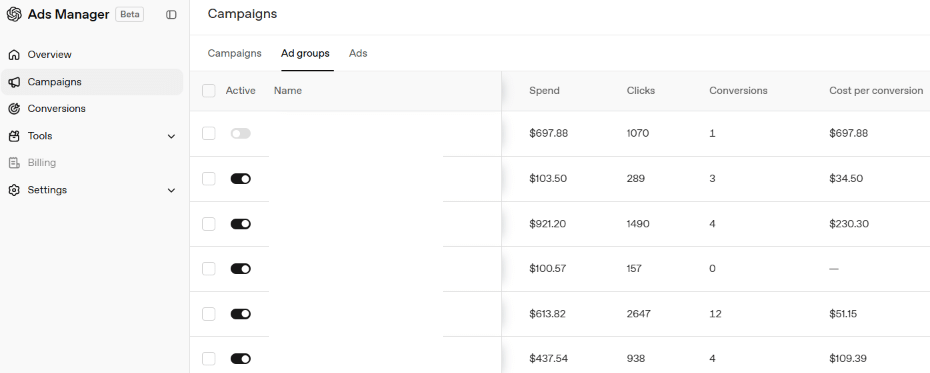
The exported results covered six ad groups and 28 ads.
| Metric | Recorded result |
|---|---|
| Impressions | 270,587 |
| Clicks | 6,591 |
| Click-through rate | 2.44% |
| Average CPC | $0.44 |
| Reported conversions | 24 |
The results demonstrate that ChatGPT Ads was able to generate relatively inexpensive clicks for this particular enterprise software campaign. The overall click-to-conversion rate was approximately 0.36%, producing a cost per reported conversion of US$119.77. Compared to some of these benchmarks, the average paid CPL in cyber is US$411, so this is almost 4 times below the average.
These benchmarks are directional references, not equivalent experiments. Our ChatGPT Ads cost per reported conversion includes eight contact/trial submissions and 16 content downloads, whereas published benchmarks use their own lead definitions. The samples also differ in advertisers, geographies and campaign objectives. Therefore, these figures cannot establish that ChatGPT Ads generates qualified enterprise leads more cheaply than in this benchmark. However, our pilot results justify further testing to determine whether conversational advertising can generate commercially relevant demand at competitive costs.
Which conversational contexts performed best?
The campaign showed substantial differences between ad groups.
| Advertising theme | Clicks | Reported conversions | Average CPC | Cost per conversion |
|---|---|---|---|---|
| Independent disaster recovery | 2,647 | 12 | $0.23 | $51.15 |
| Virtualisation | 289 | 3 | $0.36 | $34.50 |
| Ransomware recovery | 1,490 | 4 | $0.62 | $230.30 |
| Enterprise platforms | 938 | 4 | $0.47 | $109.39 |
| Containers | 1,070 | 1 | $0.65 | $697.88 |
| High-performance computing | 157 | 0 | $0.64 | Not measurable |
| Total | 6,591 | 24 | $0.44 | $119.77 |
Two observations stand out. First, the independent disaster recovery theme attracted the greatest number of clicks and reported conversions while achieving the lowest CPC. It generated 50% of the campaign’s recorded conversions. Second, virtualisation achieved the lowest cost per reported conversion at $34.50, although its three conversions are too small a sample to establish consistent performance. The difference between themes suggests that the business problem chosen for conversational targeting may be as important as the overall product category. This is a useful hypothesis for future optimisation.
Did ChatGPT Ads generate genuine B2B enquiries?
ChatGPT Ads Manager reported 24 attributed conversions. We independently identified eight conversions through UTM parameters captured in website contact and trial forms. The remaining 16 conversions were content downloads.
Our review of the contact and trial enquiries identified several indicators of commercial intent, including enterprise-scale requirements, requests for software pricing and evaluations of alternatives to existing backup solutions. These signals suggest that some visitors were actively assessing potential purchases rather than simply consuming informational content.
These examples provide direct evidence that ChatGPT Ads attracted prospects with relevant technical requirements and, in some cases, explicit purchasing intent. The practical lesson is that platform reporting should be supplemented with first-party lead records. In this pilot, those records provided stronger evidence of commercial relevance and justified further investment.
What did I learn from the pilot?
My main finding is that ChatGPT Ads performance can vary considerably according to the business problems used to structure ad groups. Broad enterprise software messages did not necessarily produce the most efficient conversion results. More specific situations, particularly those concerning independent recovery and virtualisation, generated stronger early outcomes. The test also reinforced the need to separate three questions:
- Can conversational advertising attract relevant visitors at an acceptable cost?
- Can those visitors be converted into enquiries through suitable landing pages and offers?
- Do those enquiries become sales-qualified opportunities and customers?
The available campaign data answers part of the first question and provides preliminary evidence for the second. It does not yet establish the third, but this will be seen after the deal cycle passes for this particular advertiser. For enterprise B2B advertisers, I would therefore recommend testing several distinct buyer problems, allocating enough budget to evaluate differences, and optimising against sales-qualified outcomes rather than CPC alone. The strongest early result was not simply inexpensive traffic. It was the indication that specific conversational problems could outperform broad product-category advertising within the same campaign.
What questions do advertisers commonly ask about ChatGPT Ads?
Can ChatGPT Ads target an exact user prompt?
No exact-match prompt placement is guaranteed. Context hints can guide relevance, but they are not the same as keyword match types in Google Search Ads.
Can advertisers see the ChatGPT conversations behind ad clicks?
No. OpenAI states that private conversations are not shared with advertisers. Advertisers work with aggregated ad reporting and their own post-click, consent-appropriate measurements.
Why do Ads Manager and Google Analytics show different conversion totals?
Attribution windows, view-through credit, timing, consent, tracking configuration and event definitions can differ. Reconcile those differences before interpreting a discrepancy as lost leads.
How much should a business spend on a first test?
There is no universal defensible budget. Estimate the number of meaningful opportunities needed for a decision, your acceptable cost per opportunity and the spend you can risk without disrupting established channels. Actual delivery depends on bids, competition, targeting and account eligibility. The minimum daily budget available in Australia as of now is A$25.
Do paid ChatGPT Ads improve organic mentions by ChatGPT?
Buying ads does not change ChatGPT’s answers or guarantee organic recommendations. Organic AI visibility and advertising are separate activities that should be measured separately.
How can I help assess whether ChatGPT Ads are worth testing?
I am Andrei Iunisov, Adelaide-based fractional CMO, growth advisor, and marketing leader with 19+ years of experience. If you’re evaluating ChatGPT Ads, my PPC consulting can help define a pilot scope, review the measurement setup, assess landing-page fit and compare results with established channels. The decision to spend should follow a clear hypothesis and acceptance criteria—not the novelty of the platform.